
Roman Scenes of Pompeii & the Legend of Romulus and Remus
A screen-free textile journey into Roman history, mythology and hand-made storytelling
What if children could step into the world of ancient Rome not through a screen or worksheet, but through texture, colour, weaving and story?
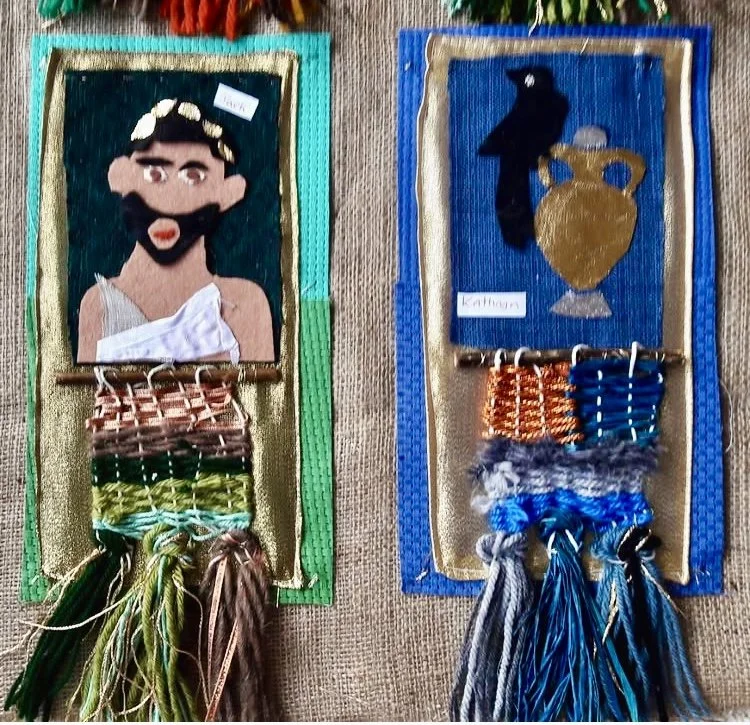
Roman Scenes of Pompeii & the Legend of Romulus and Remus is a richly tactile textile project that introduces children to Roman history and mythology through weaving, cutting, sewing and storytelling. Working entirely away from screens, children explore both the vivid visual world of Pompeian frescoes and the legendary tale of Romulus and Remus, then translate these inspirations into fabric by creating their own small woven and sewn wall hanging.
Across the sessions, children discover how colour, material, symbol and story can all be woven together. They learn about ancient Roman life, beliefs and visual culture while also developing practical making skills and a deeper appreciation for hand-crafted work.
9 to 12 years old
90 min. 3-4 sessions
Wednesday, Thursday and Friday
Roman History
-
Myth & Storytelling
-
Craft & Making
-
Natural Materials
-
Brief & Identity
-
Roman History - Myth & Storytelling - Craft & Making - Natural Materials - Brief & Identity -
Pompeii, myth and material
One of the most compelling things about this project is the combination of real history and legendary storytelling.
Children are introduced to the visual richness of Pompeii, with its frescoes, decorative patterns and Roman colour palettes, while also exploring the famous myth of Romulus and Remus, a story full of symbolism, place, identity and imagination. This blend allows the sessions to feel both grounded and magical.
Through this pairing, children begin to see that history is not only about what happened, but also about what people believed, valued and passed on through stories. Their textile piece becomes a way of responding to both the visual world and the storytelling world of ancient Rome. Children are supported to engage with history through their hands, allowing learning to feel embodied, memorable and meaningful.

Textiles, Weaving & Storytelling Project
This project offers children a particularly rich way to experience history: through their hands.
Rather than learning about ancient Rome only through facts, children are invited to engage with it materially and creatively. They look at Roman imagery, hear stories from mythology, explore colour palettes and symbols, and then respond by making their own textile artwork inspired by what they have discovered.
This makes the learning feel much more memorable and alive. The world of Rome becomes something they can touch, interpret and shape for themselves, rather than something distant and abstract. Through weaving and sewing, children also come to understand that craft has always played an important role in culture, identity and daily life.
9 to 12 years
90 minutes per session
3-4
Up to 3 children
In-person, fully screen-free
Age Group:
Duration:
Sessions:
Group Size:
Format:
WHAT CHILDREN WILL EXPLORE & LEARN
Led by a qualified Primary School teacher and former SENCO, sessions are calm, structured and responsive.
Tasks are broken into achievable steps, with flexibility for different abilities, interests and confidence levels. Children are supported to engage with history through making, allowing the learning to feel embodied, memorable and meaningful rather than abstract.
This careful teaching approach helps children feel secure while also encouraging independence, curiosity and genuine creative engagement.
-
Learning simple weaving techniques using mini card looms.
Cutting, arranging and layering fabric to create pictorial scenes.
Sewing or gluing textile elements with care and precision.
Developing patience, focus and fine motor control.
-
Exploring daily life in Pompeii before the volcanic eruption.
Learning the legend of Romulus and Remus and its role in Roman identity.
Considering how Romans may have interpreted natural disasters as messages from their gods.
Understanding how myth, belief and storytelling shaped ancient societies.
-
Studying Pompeian frescoes and Roman decorative styles.
Selecting historically inspired colour schemes (ochre, terracotta, berry tones).
Translating drawn images into simplified fabric templates suitable for cutting and sewing.
-
Locating Pompeii on a map.
Learning basic facts about volcanoes and the geography of the region.
Understanding how Romans sourced materials such as wool and clay from nature.
PROJECT ESSENTIALS
Materials Provided
All materials are supplied, including:
- Wool organised in Roman-inspired colour palettes.
- Felt, binca and hessian fabrics.
- Card for mini looms and natural twigs for hanging.
- Fabric glue, needles, gold and silver thread.
- Decorative trims and scissors.
- Visual references of Pompeian frescoes and Roman mythology.
Safety & Accessibility
Child-safe scissors are used throughout.
Sewing is optional; needle sizes are chosen carefully for ease and safety.
Clear guidance is given around calm, safe handling of tools-
The project has been successfully adapted for SEN children, particularly as a language-rich activity supporting sequencing, storytelling and vocabulary (e.g. over, under, until, etc.).
Pricing
1 child: from £80 per session.
2 children: from £120 per session.
3 children: from £180 per session.
WHY PARENTS LOVE IT
A screen-free fusion of history, craft and storytelling.
DEVELOPS PATIENCE, FINE MOTOR SKILLS AND SUSTAINED FOCUS.
iNTRODUCES ANCIENT HISTORY IN A TANGIBLE, AGE-APPROPRIATE WAY.
pROduces a unique, display-worthy textile artwork.
SMall-group format with individual attention.
Encourages deep, thoughtful engagement rather than surface learning.
Get started today
About the Project Leader
Lucy
Qualified Primary School Teacher (PGCE) with over 30 years of classroom experience.
Extensive Continuing Professional Development (CPD) in art education with leading institutions including:
Bow Arts Trust
Tate Modern
The Line
The Visual Arts Foundation
London Gifted & Talented
Designed and delivered whole-school CPD on sculpture, supporting and training class teachers.
Since 2003, has created and led bespoke art workshops for children aged 6–11, thoughtfully tailored to curriculum and enrichment themes including: History and cultural studies, Science and nature, Multi-faith and global stories, PSHE, Maths through creative exploration.
Strong background in fashion, sewing, and upholstery, bringing practical, tactile skills into her sessions.
Led large-scale intergenerational costume-making workshops involving children, parents and grandparents, with themes such as: Insects, The Lion King, African animals, Arabian Nights, Ancient Egypt.